When your parents were young, people could buy cigarettes and smoke pretty much anywhere — even in hospitals! Ads for cigarettes were all over the place. Today we’re more aware about how bad smoking is for our health. Smoking is restricted or banned in almost all public places and cigarette companies are no longer allowed to advertise on TV, radio, and in many magazines.
Almost everyone knows that smoking causes cancer, emphysema, and heart disease; that it can shorten your life by 10 years or more; and that the habit can cost a smoker thousands of dollars a year. So how come people are still lighting up? The answer, in a word, is addiction.
Once You Start, It’s Hard to Stop
Smoking is a hard habit to break because tobacco contains nicotine, which is highly addictive. Like heroin or other addictive drugs, the body and mind quickly become so used to the nicotine in cigarettes that a person needs to have it just to feel normal.
People start smoking for a variety of different reasons. Some think it looks cool. Others start because their family members or friends smoke. Statistics show that about 9 out of 10 tobacco users start before they’re 18 years old. Most adults who started smoking in their teens never expected to become addicted. That’s why people say it’s just so much easier to not start smoking at all.
How Smoking Affects Your Health
There are no physical reasons to start smoking. The body doesn’t need tobacco the way it needs food, water, sleep, and exercise. And many of the chemicals in cigarettes, like nicotine and cyanide, are actually poisons that can kill in high enough doses.
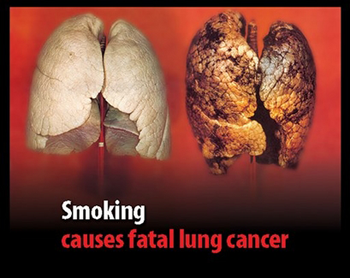
Healthy Lung and Diseased Lung
The body is smart. It goes on the defense when it’s being poisoned. First-time smokers often feel pain or burning in the throat and lungs, and some people feel sick or even throw up the first few times they try tobacco.
The consequences of this poisoning happen gradually. Over the long term, smoking leads people to develop health problems like heart disease, stroke, emphysema (breakdown of lung tissue), and many types of cancer — including lung, throat, stomach, and bladder cancer. People who smoke also have an increased risk of infections like bronchitis and pneumonia.
These diseases limit a person’s ability to be normally active, and they can be fatal. In the United States, smoking is responsible for about 1 out of 5 deaths.
Smokers not only develop wrinkles and yellow teeth, they also lose bone density, which increases their risk of osteoporosis, a condition that causes older people to become bent over and their bones to break more easily. Smokers also tend to be less active than nonsmokers because smoking affects lung power.
Smoking can also cause fertility problems and can impact sexual health in both men and women. Girls who are on the pill or other hormone-based methods of birth control (like the patch or the ring) increase their risk of serious health problems, such as heart attacks, if they smoke.
The consequences of smoking may seem very far off, but long-term health problems aren’t the only hazard of smoking. Nicotine and the other toxins in cigarettes, cigars, and pipes can affect a person’s body quickly, which means that teen smokers experience many of problems.
Hookahs and E-Cigarettes

A Girl Smoking Hookah
It’s not only cigarettes that get people dependent on tobacco. Hookahs, staples of Middle Eastern café society, are water pipes used to smoke tobacco through a hose with a tapered mouthpiece. There’s a myth going around that hookahs are safer because the smoke is cooled when it passes through the water.
But take a look at the black, resinous gunk that builds up in a hookah hose. Some of that gets into users’ mouths and lungs. Indeed, experts say hookahs are no safer than cigarettes — and since they don’t have filters and people often use them for long periods, the health risks might be even greater. Hookahs are usually shared, so there’s the additional risk from germs being passed around along with the pipe.

Electronic cigarettes in a pack
Also beware of electronic cigarettes (e-cigarettes), which contain cancer-causing chemicals and other toxins, including a compound used in antifreeze. These battery-operated devices use cartridges filled with nicotine, flavorings, and other chemicals and convert them into a vapor that’s inhaled by the user.
E-cigarettes haven’t been evaluated or approved by the U.S. Food and Drug Administration (FDA), so they don’t have to post the health warnings that nicotine replacement products or conventional cigarettes do. But there’s no such thing as a safe nicotine product.

