Although there is still tobacco in the fields to be picked, Robeson County growers are already calling this year’s projected harvest the worst in a long line of disappointing yields for the crop that was once their most reliable and profitable.
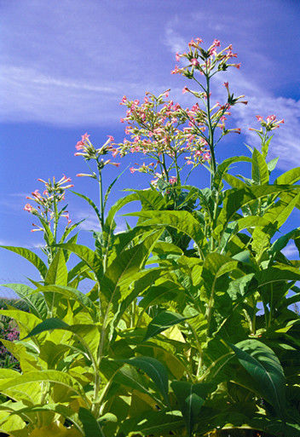
Bloomy tobacco plant
Once considered the golden leaf, local farming officials say that tobacco isn’t turning the same profit and is occupying fewer acres on county farms than ever before.
“Tobacco, as we know, it is over,” said Roger Oxendine, a Robeson County commissioner and one of the area’s largest farmers. “It’s a dying breed.”
Oxendine said that 10 years ago, he got about $2.05 a pound for tobacco. Now prices have dropped by nearly a third to around $1.50.
Compounding the problem this year is that drought and disease have devastated his tobacco crop. Oxendine said that in dry, hot weather, like that experienced during the nearly two-month drought that descended on the county in July, the root system of the tobacco plant doesn’t mature. making the crop susceptible to diseases.
Mac Malloy, the county field crops agent with the Agricultural Extension service, estimates that farmers could see a 30 percent drop in yield this season. The county averages 2,200 pounds of tobacco per acre, Malloy said, but averages this year are expected to be about 1,500 pounds.
Oxendine said he expects even less, saying nearly half of his crop was riddled with disease.
Because of those conditions, the tobacco crop is considered “second quality,” Oxendine said, and the cigarette companies aren’t interested in buying it.
Oxendine said he remembers starting farming in 1972, taking the reigns from his father and his grandfather when the country’s consumption of tobacco was so great that the crop sold itself.
“It was like you couldn’t grow enough,” Oxendine said. “But now the attitude has changed and now it’s like they don’t want your tobacco.”
According to the Associated Press, the number of Americans smoking has dropped dramatically since 1970, from about 40 percent to 20 percent. But the rate has remained at 20 percent — about 45.5 million Americans — since about 2005.
Cigarette manufacturers like Phillip Morris and R.J. Reynolds contract independently with farmers to raise their crops, so farmers only grow tobacco if they have a contract with an interested buyer.
“Dry or wet, it never … let you down,” said Bobby Davis, another county farmer. “It was the future.”
Davis said he currently farms about 4,000 acres — 300 of which are tobacco. Davis has increased the acreage of tobacco on his farms from 150 acres to his current 300 in order to make the same profits from the crop.
Oxendine said he has gone in the opposite direction. He was reduced his tobacco acreage by about 200, leaving him with about 650 acres of tobacco during the last three years. He is looking at growing even less tobacco next year.
According to Malloy, the county had about 10,000 acres dedicated to tobacco in 1999, ranking it third in the state for tobacco production. Malloy said that the farmers produced about 20 million pounds of tobacco that year, which totaled about $25 million.
Compare that with 2009, when the county only produced about 8 million pounds on 4,000 acres, with a value of about $10 million.
“It was the cash crop for Robeson County,” Malloy said. “But we don’t see the acreage like there was.”
Since 2002, tobacco farms statewide have decreased production by about 70 percent.
Tobacco is labor intensive, said Malloy, which could account for the decrease in the industry on several levels.
Tobacco leaves used to be picked by hand, he said, and farmers probably couldn’t find the labor to help them or didn’t want to make the investment for the equipment to upgrade. Also, the average age of a Robeson County farmer is around 58 years, he said, and many farmers took the government buyout in 2004.
Oxendine said that he employed as many as 32 people during the tobacco season this year, but if he were to quit farming tobacco, he would only need about six people to maintain the rest of his 7,300 acres.
“I wouldn’t dare to imagine how many jobs have been lost with people quitting tobacco,” Oxendine said.
The profits that farmers are getting for their other crops are increasing, while the price of tobacco is decreasing, causing most farmers to diversify their crops.
Soybeans, wheat and corn are the cash crops in the county now, Malloy said.
“A good acre of corn will get you the same as a good acre of tobacco these days,” Davis said.

